Wednesday, 28 June 2023

01-032 Table-played playing cards

01-032
Table-played playing cards

I have bought 4 packs of playing cards from Amazon at a cost of USD 12.79. They are not ordinary playing cards. The manufacturer is “Bee”. The cards are printed in USA, in top casino quality. And most importantly, they are used.


Table-played playing cards

On Amazon, a box of 12 pack brand new “Bee” playing cards only costs USD 24.99. Why should I spend more than 3 bucks on a pack of used cards, when a pack of brand new cards would just cost me 2 bucks? The reason is, these cards are the real deal. The cards are real Vegas casino playing cards that actually been used by official dealers at popular Las Vegas casinos.


Cards are printed by the US manufacturer "Bee"

Casinos have to periodically remove playing cards from circulation to prevent gamblers from using marks on them to gain an advantage. Ideally, all playing cards must be replaced at the end of each 8 hours shift. But in practice, the dealers have all the rights to replace the cards whenever they feel necessary, which can be as frequent as half an hour. You can imagine after a day of operation, there would be millions of used playing cards heading to landfill.


The pack is resealed with a label saying
the deck was actually played on casino table

Some casinos collect those used cards, clip the corners or stamp a hole straight through the center of the deck to show that they have already been used in play. This helps to reduce fraud, and it is also a way to show that the pack of cards was used at a genuine table in an official game. Each card receives the same treatment equally, which makes these playing cards useful for gaming outside of their original homes.


Cards are in French suits with jumbo-sized corner index

The used cards, and their boxes, are then sent to local community centers. Inside, people manually sort the 52 cards in order, seal them with a label and resell the cards to the second hand market. Table-played playing cards are not only cards with a story behind. Purchasing them can also help the local community.

Tabled-played playing cards are in French-suit with jumbo-sized index on four corners, allowing a much easier gameplay on casino tables. Cards are for real money business so their qualities are always the topmost. Jokers are removed as there are no rooms for them in the Vegas.


Casino logo is printed on the backside

My packs are from 3 different casinos of Las Vegas – Golden Nugget (1946), Atlantis (1972) and South Point (2005). Two of these casinos are even older than me.

The decks can be used to play any games that do not require a Joker. But as the cards are from casino tables, why don’t we use them to play Blackjack? 

General Information

Player

2 to 10

Playing Time

30 mins

Age

8+

Year Released

1700

Designer

(Public Domain)

Publisher

Bee

Family

Betting and Bluffing, Push your luck

Score

4.7 (Board Game Geek)

Specifications

Card size

Poker size

(63mm x 88mm, 2.5" x 3.5")

Deck size

52 cards

# of suits

4 – diamonds (♦), clubs (♣), hearts (♥) & spades (♠)

Details

For each suit, there are:

1x A
1x 2
1x 3
1x 4
1x 5
1x 6
1x 7
1x 8
1x 9
1x 10
1x J
1x Q
1x K 

And there are no Jokers.

Gameplay

Where to buy?

Amazon.


Go back to the Lobby ...


Tuesday, 27 June 2023

04-017 Dim Sum

04-017
Dim Sum

I always want to write something about Dim Sum.


Dim Sum, and a pot of Chinese tea

Dim Sum is probably the most well-known Chinese cuisine throughout all nations. There are plenty of information about Dim Sum available on the internet. Wikipedia has a full list of all different kinds of Dim Sum in it, with photos. But I still want to write something about Dim Sum. I want to tell you the local definition of Dim Sum, different kinds of Dim Sums that can be found in Hongkong, how they look like, and how much do they cost.

The meaning of Dim Sum

Let us begin with the meaning of Dim Sum. Literally, Dim Sum means “a piece of heart”. Dim Sums are snacks. They are small in size and difficult to make. Therefore, each piece of Dim Sum is made with “a piece of heart”.

In the old time, Dim Sums are for the emperors or the nobles. They ought to be expensive. In modern day, although price of Dim Sum has dropped to an affordable range, it is still not a cheap food that people would consume in every meal.

Common Hongkong style Dim Sum

Below are common kinds of Dim Sum that you can find in Hongkong. I have been eating these Dim Sums since young. Like many other foods, the shape and taste of Dim Sums change over time. But some of them are still retaining their original shape and taste and has not been changed for decades.

Please note that I am not saying only the dim sums serve in Hongkong are “authentic”. Dim Sums were originated in Canton, but no one owns the copyright of making Dim Sum. Any people can make Dim Sums in their own style. So, if you go to your local Chinese restaurant, you will find the same Dim Sum looks slightly different in your country.

Also, the photos below were taken from different restaurants in different dates. But all photos are taken locally.

Shrimp Dumpling, Siumaai & Steamed meatball

There are around 100 different kinds of Dim Sums available. But the topmost common Dim Sum dishes are always Shrimp dumpling (蝦餃), Siumaai (燒賣) & Steamed meatball (山竹牛肉).


Shrimp dumpling


Siumaai


Steamed meatball

Shrimp dumplings are made with shrimps and bamboo shoots. Their skins are made by very special flour to give a sticky texture. Siumaai is made by minced pork and shrimps. And Steamed meatball is a mixture of beef and pork, although its Chinese name only says beef. All 3 dishes are steam cooked.

Dishes for chicken fanatic

Chicken roll
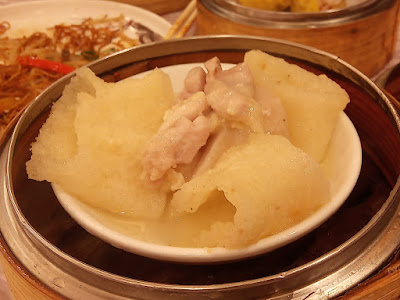

"Cotton" chicken

Four-treasure chicken roll, or simply Chicken roll (雞扎), “Cotton” chicken (棉花雞) and Phoenix claws (鳳爪), a.k.a. Chicken feet, are the most common chicken dishes. Chicken roll is typically chicken, ham, yam, ocean stick, fish maw, pig skin and Chinese mushroom, all wrapped in a thin slice of tofu skin. “Cotton” chicken is similar except all the ingredients are placed on a dish, not wrapped. The word “cotton” refers to the piece of fish maw, which looks like cotton. Phoenix claws are probably the most horrible dish in the eyes of Westerners. All 3 dishes are steam cooked.

Spareribs and Reticulum beef tripe

Beef tripe and Pheonix claws


Spareribs

Spareribs (排骨) and Reticulum beef tripe (金錢肚) are probably the most traditional Dim Sum dishes. I remembered back in the 80s, I traveled to mainland China with my parents. In a village restaurant in Canton, Spareribs are the only 2 Dim Sums served. The other is Barbeques pork bun. Both ribs and tripes are steam cooked.

Rice noodle rolls

Rice noodle rolls with fillings
The rolls in the photo is barbequed pork

Rice noodle rolls without fillings

Rice noodle rolls (腸粉) are another popular dishes. Rice noodle rolls are almost impossible to make at home, so people eat them in restaurants. There are 2 types, with fillings or without fillings. Fillings are normally prawns, beef, barbequed pork, chicken, or vegetable. You can only choose 1 filling per dish, not a mix. Rice noodle rolls without fillings are normally thinner and served with sweet or chili sauce. Rice noodle rolls with fillings are steam cooked. Rice noodle rolls without fillings can be steam cooked or shallow fried.

If you need some starch


Barbequed pork bun


Sweet cream bun

There is a wide selection of Chinese buns available to fill up your stomach. And the most common ones are definitely Barbequed pork bun (叉燒包) and Sweet cream bun (奶黃包). Chinese buns are not baked but steamed. We don’t use yeasts in making buns. They taste very different from bread. Try, but you may not like.

Where to find Dim Sum in Hongkong and how much?

Traditionally, Dim Sums are only served in Chinese restaurants during breakfast, lunch, and afternoon teatime. Because of their popularity, supermarkets have started selling frozen Dim Sums for home cooking for many years. But normally, frozen Dim Sums are in smaller version and taste a bit different from their originals. In recent years, many roadside Dim Sum takeaway stores appeared in Hongkong, selling the same versions of Dim Sums as in Chinese restaurants.

Depends on the class of the restaurants you visit, a dish of Dim Sum ranges from USD 4 to USD 10. And there is always a 10% service charge added to the bill. The service charge will be 20% during Chinese New Year, 30% on the Chinese New Year day. And they also charge around USD 1 to 2 per person for the Chinese tea.


Dim Sum record card of a local restaurant

Most restaurants serve other Chinese dishes, such as fried rice and noodles, alongside with Dim Sums. Some dishes can be small in size but are not considered as Dim Sums.


Backside of the record card includes other dishes apart from Dim Sums

Roasted belly pork, served together with other Dim Sums
but itself is not a Dim Sum

A pack of frozen Dim Sums from supermarket normally costs USD 3 to 4. And the price of a Dim Sum dish on roadside Dim Sum stores costs USD 2 to 3 only. Their Dim Sums are cooked, hot and can be eaten immediately. That is also why roadside Dim Sum stores are so popular in Hongkong.

Washing the bowls, spoons and chopsticks before eating

Before stop writing, let me also tell you a very common but rather strange practice that we normally do when dining in Chinese restaurants. It is washing the bowls, spoons, and chopsticks with hot tea before eating. The reason is to make sure the eating utensils are clear and soap free. Restaurants also provide us a bigger bowl to hold the dirty water.


Washing chopsticks with tea

In most people’s eyes, this is indeed a very odd practice! An American friend asked me when I was washing the utensils in a Chinese restaurant, “Won’t the staffs feel insulted?” This is a good question. Doing the same in a French restaurant would most likely end up being kicked out! But this is a common practice we do in Chinese restaurants. Don’t worry! We have plenty of Western restaurants in Hongkong. And we only wash the utensils in Chinese restaurants, not anywhere else. And if you don’t want to wash the dish before eating, it is also fine.


Go back to the Lobby ...


Friday, 23 June 2023

04-016 Demae Itcho

04-016
Demae Itcho

Rice and noodles are the main staple food in Chinese culture. We eat rice and noodles almost every day. Traditionally, rice is the main staple food for southern part of China. While in the north, because of the cooler weather, wheat grows better than rice. Noodles are more popular in the north.

However, rice cooking took more than 40 minutes. Cooking a bowl of noodles only takes 10. Noodles adopt much better than rice in this busy city.

But there is a slight problem on preparing noodles. Cooking noodles has more steps than cooking rice. You need to boil the noodles first, rinse them in cold water and recook it before eating. Also, traditional noodles are made fresh and can only store for a few days. It is not the cooking part but the buying part that bothers most people. Noodles stores inside wet markets are closed after office hours. Office workers can only manage to buy fresh noodles during the weekends. And they have to finish them in a couple of days or else the noodles spoil.


Demae Itcho, served with luncheon meat

Things changed in 1969. Nissin Food created the first bowl of Demae Itcho 出前一丁 in Japan and imported it to Hongkong in the next year. Demae Itcho is not the first instant noodles ever made. But it is the first instant noodles that has a separate packet of the soup powder. Demae Itcho also uses sesame chili oil alongside its soup to create a richer and spicier flavor.

Soon, Demae Itcho became one of the most popular unhealthy foods in the city, thanks to MSG. Parents keep telling their children not to eat too much but continue feeding them Demae Itcho almost every lunch. In 1985, we have our local Demae Itcho factory.


Menu of local restaurant "Canteen" has a Demae Itcho section


Piles of Demae Itcho before cooked


Set C2 on the menu -- Demae Itcho with spiced pork cube and fried egg

Now, the term “Demae Itcho” becomes a local equivalent to instant noodles. Demae Itcho also becomes a part of local culture. Most tea restaurants (Cha Chaan Teng 茶餐廳) in Hongkong have instant noodles on their menus. Many emphasize that their instant noodles are all Demae Itcho, not any other brands. Some serve other brands but provide Demae Itcho as an upgrade option, charging $5 extra per bowl. In order to prove that the instant noodles are really Demae Itcho, they will give you the packet of sesame oil. A sesame oil packet comes with each Demae Itcho pack. It somehow serves as a “Proof of purchase”.


Set C1 on the menu -- Demae Itcho with luncheon meat and fried egg
Note the sesame oil pack "proof of purchase"


My son is a big fan of Demae Itcho

Apart from eating outside, Demae Itcho is always a hot item in supermarket. And it is developed into many different flavors, beef, seafood, curry, etc. Each pack costs around US 40 to 50 cents.


Different flavours of locally produced Demae Itcho

Some shops import Demae Itcho from Japan. Their taste is a bit different from the locals. The noodles are made by wheat grown in Hokkaido and tastes a bit saltier. And instead of just oil, there are sesame grains inside the sesame oil packet. An imported pack costs around US 70 to 80 cents.


Imported Demae Itcho, selling at a much higher price

Nissin also sells macoroni under the Demae Itcho brand

Some smaller shops even sell "industrial grade" Demae Itcho to individuals. "Industrial grade" Demae Itcho is sold to restaurants as a bulk pack and is not intended to be sold separately. It tastes the same as a normal Demae Itcho. But the packet does not have the transparent open window on it. "Industrial grade" Demae Itcho is not necessarily cheaper than normal Demae Itcho. It is just that the shop wants to seek a cheaper source and maximize the profit.


"Industrial grade" Demae Itcho

Go back to the Lobby ...


Wednesday, 21 June 2023

06-007 Payload Specialist, the true meaning behind the title

06-007
Payload Specialist, the true meaning behind the title

May, 2023 is another exciting month for space enthusiasts. We first saw Axiom Mission 2 sending 4 astronauts to ISS on the 21st of May. Three days later, we saw Virgin Galactic resuming their sub-orbital flight, introducing 3 new faces to the space. Then in less than 48 hours before month end, China successfully launched our Shenzhou 16 spacecraft to Tiangong Space Station. Adding 2 new taikonauts to the Shenzhou “Hall of Fame”.

Since the beginning of the month, many people have started guessing who will be on board of Shenzhou 16. It was not an easy guess. Difference from NASA, China Aerospace Science and Technology Corporation (CASC) only announces the names of taikonauts a few days before a scheduled space flight. Identities of taikonauts are state secret. Now, everyone knows who they are. And to our surprise, there is a distinguishing face among the 3 chosen ones.

Gui Haichao, our first Payload Specialist


Payload Specialist Gui Haichao

Chinese researcher Gui Haichao is the one passenger that drew the most attention. He is young, handsome, and smart. He is only 36 but is already a professor. Most importantly, he is the first civilian taikonaut in the world. Prior to the launch of Shenzhou 16, we have already sent 16 taikonauts to the space. But all of them are from the military, including our first taikonaut Yang Liwei and our beautiful “Teacher in space” Wang Yaping. Gui Haichao is the first non-military personal on board of a Shenzhou spacecraft.

Medias, both Chinese and Western, were attracted by his young face. People were busy finding out who he is and his past achievements on academic. Some viewed sending Gui to the space as a big milestone of Chinese space program. Some asked why a taikonaut can wear glasses. But they all missed one point. Gui is not only the first civilian taikonaut. He was also given a title on his mission, a Payload Specialist.

The meaning behind the title

Why is the title "Payload Specialist" so important? If Payload Specialist only means civilian space traveler to you, full stop, then you miss the point. Yes, Gui is a specialist, of course. He is a professional. And he is a civilian, for sure. But his title Payload Specialist has a special meaning, not to Gui himself, but to NASA.

This is not a title invited by CASC. Payload Specialist is a NASA term. Back in the 80s, NASA has started sending civilian astronauts to the space for short scientific missions. Altogether, NASA has sent 60 Payload Specialists to the space. Among them, we saw the first Chinese astronaut, Taylor Gun-Jin Wang. But sad things happened. 3 Payload Specialists were killed in their missions, 2 in the Challenger disaster and 1 in the Columbia disaster. Since then, NASA terminated the program.

Nowadays, civilians are still being sent to ISS, but under a different title Mission Specialist. CASC reused this old title for Gui Haichao has a meaning to NASA. CASC is telling everyone that, we are now picking up the job that NASA gave up. “You don’t do it? Let me do it!”

Back in 2007, Barbara Morgan hosted the first ever space lecture of mankind on the ISS. But NASA is not doing this anymore. So, Wang Yaping picked up the job and did this on Tiangong. “You don’t do it? Let me do it!” Same principle.


Go back to the Lobby ...


Tuesday, 20 June 2023

04-015 Shark fin soup

04-015
Shark fin soup

A couple of months ago, I got a chance to join a banquet. The banquet is held in a local Chinese restaurant. And I got a chance to try, probably, the most infamous dish in Cantonese cuisine, the Shark fin soup.


Shark fin soup

The consumption of shark fins can be traced back to the medieval age. Shark fins as a delicacy in Chinese cuisine appeared during the Ming Dynasty in China around 600 years ago. The dish was prepared for emperors at big celebrations such as wedding banquets and large gatherings. However, it soon became common fare at big parties like weddings and other important events. Today, shark fin soup is still considered a delicacy in many parts of the world, especially among us, Chinese people.

I eat shark. I don’t think eating shark is anything weird. It is just a bigger fish. It is true that because of its feeding nature, sharks contain many toxic chemicals and heavy metals in their body. Overconsuming shark meat can be harmful. But shark fin is an expensive ingredient. I don’t think many people can afford eating it every day, not to mention overconsuming. My only concern of eating shark is the sustainability of wildlife.

Every year 100 million sharks are killed by the fishing industry. This is doing enormous damage to the ecosystem of the ocean. The number of sharks found in the open oceans has plunged by 71% over half a century, mainly due to overfishing. More than one-third of shark species are threatened with extinction.


Not sure if this claim is valid.
But this warning has no effect to,
at least, half of the world's population.

In recent years, there are voices among the locals on calling people to avoid shark meat consumption. Some local merchants support that. The Chinese restaurant in Hong Kong Disneyland, for example, does not serve shark fin soup. Cathay Pacific Airways also refuse to carry any cargos that contain shark fins. But shark fin consumption is still popular in the city. We do not eat this every day. But when it comes to banquet, you can always find it on the menu.

My conscious on shark consumption is, if I can make decision on the banquet menu, I will avoid. But if I am being served shark fin soup in a banquet… Well, the fish is dead anyway.

In order not to let the poor little baby shark dying in vain, let me show you how shark fin soup looks like and how it is served.


Menu of a Chinese banquet

A Chinese banquet normally contains 8 to 12 different dishes. Shark fin soup is served in the midway, usually being the third or the fourth dish of the banquet. It is also the toasting time. So, when you see the waiter or waitress put a bowl of shark fin soup on your table, prepare your liver.


Waitress serving Shark fin soup

To impress the guests, shark fin soup comes in a big bowl. “See? The master is so generous and serving you a big bowl of shark fins.” Waiter will then help separating the soup into 10 to 12 smaller bowls. Corn starch is added to the soup to make it thicker. Apart from shark fins, you can also find shredded pork, chicken meat and fungus inside. Shark fins do not have any taste. The taste actually comes from other ingredients in the soup. Some people like to add vinegar to it.


This is how the shark fin soup looks like


Only the semi-transparent part inside the soup is shark fin.
The white colour meat is pork.

The texture of shark fins is like that of rice noodles. People sometimes replace shark fins with rice noodles to make a much cheaper alternative but retaining most of the original taste of shark fin soup. If you are curious on the taste of shark fin but do not want to harm any shark, look for those “imitation shark fin soup”.


Imitation shark fin soup


Go back to the Lobby ...